


Showing posts with label Incantato Performance Venues. Show all posts
Showing posts with label Incantato Performance Venues. Show all posts
Thursday, June 10, 2010
Wednesday, June 9, 2010
Finale highlight concert: The Bob Cole Conservatory Choir performs at the Kaiser-Wilhelm-Gedächtniskirche in Berlin on June 9 at 7.30 pm
Welcome to Berlin! After exciting days in the Czech Republic, the Bob Cole Conservatory Choir arrived in the German capital. At the famous Kaiser-Wilhelm-Gedächtniskirche the final tour concert will take place on June 9 at 7.30 pm.
 The Protestant Kaiser Wilhelm Memorial Church (in German: Kaiser-Wilhelm-Gedächtniskirche) is located on the Kurfürstendamm in the center of the Breitscheidplatz. The original church on the site was built in the 1890s. It was badly damaged in a bombing raid in 1943. The present building, which consists of a church with an attached foyer and a separate belfry with an attached chapel, was built between 1959 and 1963. The damaged spire of the old church has been retained and its ground floor has been made into a memorial hall.
The foundation stone for the old church was laid on March 22, 1891. The competition for the design was won by Franz Schwechten who planned for a large church to be built in neo-romanesque style, including 2,740 square meters of wall mosaic. The spire was 113 meters (370' and 8.81") in stature and the nave seated over 2,000 people. The church was consecrated on September 1, 1895. By this time of the consecration the entrance hall in the lower section had not been completed. This was opened and consecrated on February 22, 1906. In the Second World War, on the night of November 23, 1943, the church was irreparably damaged in an air raid. The church was largely destroyed but part of the spire and much of the entrance hall survived. The entrance hall in the base of the damaged spire was reopened to visitors, having been consecrated on 7 January 1987.
Its floor contains a mosaic of the Archangel Michael fighting the dragon. The vault shows a procession of Hohenzollern princes, early and more recent. Other mosaics show important monarchs in medieval Germany, Reformation thinkers and Reformation princes. Bas-relief sculptures illustrate scenes from biblical stories, scenes from the life of Kaiser Wilhelm I and symbolic figures representing war and peace. In the north apse are 16 display panels which tell the story of the old church and its destruction. At the opposite end of the hall are three items which symbolize the history of the church. In the middle is a damaged statue of Christ which originally stood on the altar of the old church. To its right is the Cross of Nails which was made from nails in the roof timbers of Coventry Cathedral. This cathedral had been severely damaged in a German air raid on 14 November 1940. To the left of the statue of Christ is an icon cross which was given by the Russian Orthodox Church and handed over in 1988. Outside the hall are four sandstone figures made by Stefan Kaehne.
The pictures are from the official website of the church.
 The Protestant Kaiser Wilhelm Memorial Church (in German: Kaiser-Wilhelm-Gedächtniskirche) is located on the Kurfürstendamm in the center of the Breitscheidplatz. The original church on the site was built in the 1890s. It was badly damaged in a bombing raid in 1943. The present building, which consists of a church with an attached foyer and a separate belfry with an attached chapel, was built between 1959 and 1963. The damaged spire of the old church has been retained and its ground floor has been made into a memorial hall.
The foundation stone for the old church was laid on March 22, 1891. The competition for the design was won by Franz Schwechten who planned for a large church to be built in neo-romanesque style, including 2,740 square meters of wall mosaic. The spire was 113 meters (370' and 8.81") in stature and the nave seated over 2,000 people. The church was consecrated on September 1, 1895. By this time of the consecration the entrance hall in the lower section had not been completed. This was opened and consecrated on February 22, 1906. In the Second World War, on the night of November 23, 1943, the church was irreparably damaged in an air raid. The church was largely destroyed but part of the spire and much of the entrance hall survived. The entrance hall in the base of the damaged spire was reopened to visitors, having been consecrated on 7 January 1987.
Its floor contains a mosaic of the Archangel Michael fighting the dragon. The vault shows a procession of Hohenzollern princes, early and more recent. Other mosaics show important monarchs in medieval Germany, Reformation
 thinkers and Reformation princes. Bas-relief sculptures illustrate scenes from biblical stories, scenes from the life of Kaiser Wilhelm I and symbolic figures representing war and peace. In the north apse are 16 display panels which tell the story of the old church and its destruction. At the opposite end of the hall are three items which symbolize the history of the church. In the middle is a damaged statue of Christ which originally stood on the altar of the old church. To its right is the Cross of Nails which was made from nails in the roof timbers of Coventry Cathedral. This cathedral had been severely damaged in a German air raid on 14 November 1940. To the left of the statue of Christ is an icon cross which was given by the Russian Orthodox Church and handed over in 1988. Outside the hall are four sandstone figures made by Stefan Kaehne.
The pictures are from the official website of the church.
Monday, June 7, 2010
Bob Cole Consevatory Choir presents Recital at Frauenkirche in Dresden on June 8 at 5:30 pm
 The Bob Cole Conservatory Choir under the direction of Dr. Jonathan Talberg was granted permission to present a special recital at the famous Frauenkirche in Dresden, Germany on June 8 at 5:30 pm during their 2010 Incantato Performance Tour to Central Europe.
The Frauenkirche Dresden can look back on a 1000-year history. Already its predecessor churches were dedicated to the Mother of God and called Frauenkirche. In the 18th century, the famous dome structure by George Bähr was built and dominated Dresden’s cityscape for 200 years. The church was destroyed shortly before the end of World War II. Its ruin remained as a memorial at the heart of the city. For more information on the history and significance of this venue, please visit the official Frauenkirche website.
Good-Bye Czech Republic!

On June 9th, The Bob Cole Conservatory Choir said Na Shledanou (farewell) to the Czech Republic, but not before they were able to visit Northern Bohemia on their way to Germany.
Here, the students visited the music department at Usti nad Labem University, met the professors and even practiced with Dr. Riha.


After their warm-up, The Bob Cole Conservatory Choir was taken to Chlumec, where they were warmly welcomed by the mayor, also Dr. Riha (the son of the choral professor), who welcomed them with refreshments.
 Then it was off to the church in Chulmec, where the group listened to a local young women's choir, under the direction of Dr. Vladimir Kuzelka, and followed it by a performance of their own!
Another Wonderful Performance by CSULB
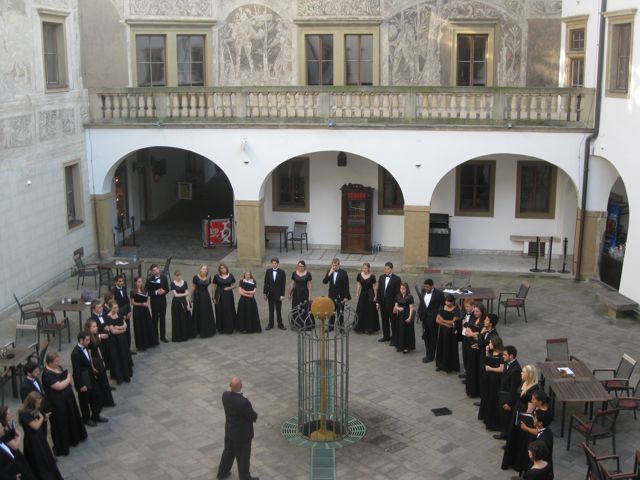
Tonight, June 7th, The Bob Cole Conservatory Choir performed at the Martinic Palace at Prague Castle. The group, directed by Dr. Jonathan Talberg, performed in this medieval room by encircling the crowd, instead of singing at the front of the room like most traditional concerts. As a result, the sound was breathtaking, and the audience insisted on an encore song!
Students Virgil Rosales and Steven Berlanga were both invited to conduct songs this evening, and they both did a wonderful job!


After the concert, Incantato arranged a reception for the group in the courtyard of the Martinic Palace, where brats were grilled, cake was served, and the beer was flowing!


Following the reception, a boat was chartered especially for the group so that they could get one last look of Prague before they leave tomorrow morning for Germany.
Good-bye Prague!
Renaissance Martinic Palace in Prague - CSULB highlight concert venue on Monday, June 7, at 7 pm
 When you visit the Prague Castle, look around at the Castle Square before the main entrance. There are several historical palaces and the Martinic Palace is one of them – it is one of the most beautiful Renaissance buildings in Prague, built in the 16 th century. There used to be a residence of Ondrej Tefl of Kinsdorf at the place. He sold the house to Jiri Borita of Martinic in 1583. Second Prague defenestration The new owner started to rebuild and enlarge the palace, but the work was discontinued by dramatic events in 1618: the Czech Protestant noblemen rebelled against Emperor Matthias, who had violated their religious freedom. Noblemen came to the Prague Castle to the office of imperial vice-regents. Jaroslav Borita of Martinic, owner of the palace, was a vice-regent at the time. The angry noblemen threw the vice-regents and their clerk out of the window. This event is known as “the second Prague defenestration” and it started the Thirty Years´War. Suprisingly, the vice-regents were not injured, but they had to run away from the country for some time. The Martinic Palace was finished in early-Baroque style later. Replica of the Royal Palace The frontage is decorated with symbol of Martinic family – a water-lily and a star. The palace was built as a half-sized replica of the Royal Palace at the Prague Castle, because Count Martinic wanted a palace, symbolizing his political power. Renaissance decoration Martinic Palace is decorated with numerous figural sgraffitoes, depicting scenes from life of Joseph in Egypt, King David and Hercules. There are well preserved Renaissance beam ceilings inside the palace. The ceilings are painted with allegorical pictures and lots of sayings are written there. Many fresco paintings adorn the Martinic Palace, for example the above-lifesized figures of Adam and Eve, painted according to the artwork by A. Dürer. The Martinic family died out in 1788 and the new owner of the building let most of the rooms for rent. The palace was badly devastated at the beginning of the 20 th century: around 70 families lived there and various workrooms were made there as well. The palace was finally restored in 1960s.
Sunday, June 6, 2010
Bob Cole Conservatory Choir the featured guest performer at Tyn Church in Prague at 9 pm on June 6
 Another prime venue awaits the CSULB singers under the direction of Dr. Jonathan Talberg on the Bob Cole Conservatory Choir's 2010 Incantato Tour to Central Europe: The Tyn Church, a landmark of Prague and also the most popular church for the inhabitants of the Czech Capital city. The singers from Long Beach California were invited to sing during a special service on June 6 at 9 pm.
From Wikipedia: The Church of Our Lady before Týn (in Czech Kostel Matky Boží před Týnem, also Týnský chrám (Týn Church) or just Týn) is a dominant feature of the Old Town of Prague, Czech Republic, and has been the main church of this part of the city since the 14th century. The church's towers are 80 m high and topped by four small spires. In the 11th century, this area was occupied by a Romanesque church, which was replaced by an early Gothic Church of Our Lady in front of Týn in 1256. Construction of the present church began in the 14th century in the late Gothic style under the influence of Matthias of Arras and later Peter Parler. By the beginning of the 15th century, construction was almost complete; only the towers, the gable and roof were missing. The church was controlled by Hussites for some time, including John of Rokycan, future archbishop of Prague, who became the church's vicar in 1427.The roof was completed in the 1450s, while the gable and northern tower were completed shortly thereafter during the reign of George of Podebrady. His sculpture was placed on the gable, below a huge golden chalice, the symbol of the Hussites. The southern tower was not completed until 1511, under Matěj Rejsek. In 1626, after the Battle of White Mountain, the sculptures of George of Podebrady and the chalice were removed and replaced by a sculpture of the Virgin Mary, with a giant holy made from by melting down the chalice. In 1679 the church was struck by lightning, and the subsequent fire heavily damaged the old vault, which was later replaced by a lower baroque vault.Renovation works carried out in 1876-1895 were later reversed during extensive exterior renovation works in the years 1973-1995. Interior renovation is still in progress.For more info, please visit: http://en.wikipedia.org/wiki/Church_of_Our_Lady_before_T%C3%BDn
Thursday, June 3, 2010
More standing ovations for the Bob Cole Conservatory Choir in Austria - Talberg: "The choir sounded amaaaaazing!"
 "I love this church", commented Dr. Jonathan Talberg on late Thursday night on the phone from beautiful Göttweig where the Bob Cole Conservatory Choir performed to a small, yet very appreciative audience in the magnificent Stiftskirche - the perfect setting for Mendelssohn's "Heilig" sung in double choir from the altar area. Rainy weather and a national holiday brought only 32 listeners to the Benedictine Abbey, but they sure made some noise. Especially two older ladies who were so moved by the concert yet also extremely upset about the lack of a full house for the singers from Cal State Long Beach that they even yelled at one of the Fathers accusing him of not spreading the word about the event more: "Das war der beste Chor, der hier je gesungen hat und keiner wusste davon", one lady said: "This was the best choir we ever had here and nobody knew they were coming". The fact that nobody knew is hard to believe as a quick google search produced about 512 results for the concert listing. Incantato's concert management team had done their homework by sending out press releases to the media along with personal invites to local fans of choral music, but the national holiday on Thursday, is for many locals, a reason to pack the whole family and go on a long weekend trip. Combined with rainy weather and floods that keep the tourists away, can result in only a small crowd. "It didn't really matter so much", Talberg added. "The choir sounded amaaaaaazing and we had a lot of fun." Last, but not least, the choir was asked for an encore and received two standing ovations - quite unusual for European audiences who are not known for showing such public displays of enthusiasum, especially not in church. "It was a perfect day", their director concluded. After departing from Bratislava, the singers from CSULB had first stopped at Melk Abbey where they had been granted permission to sing a full set of sacred selections (another rare moment) and then continued on to Goettweig for a private reception, tour and rehearsal of the magnificent abbey perched high upon a hill that looks and feels like a fairy tale castle. And the best part of the day? Well, it sounded like the night ahead of them at the former boy school dormitory right next to the pink church where the group is staying for two nights. The only downside is that we will have to wait for actual pictures at least until tomorrow. While there is a gourmet restaurant just around the corner where they had dinner already and breakfast will be served for Dr. Talberg and his students, the Abbey does not offer Wi-Fi or any internet services. Auf Wiedersehen - Sandra for the CSULB gang in Göttweig, Austria!
Wednesday, June 2, 2010
A prime venue with perks: Next Cole Conservatory Choir Concert at the Benedictine Abbey of Goettweig on June 3 at 7:30 pm
The Benedictine Abbey situated on the Göttweig Mountain, is - because of its location - sometimes called the Austrian Montecassino. The Monastery founded in 1083 by Saint Altmann sits on a hill 449 m above sea level in the Dunkelsteiner Forest south oft the city of Krems, on the eastern edge of the world-famous Danube Valley called the Wachau. With the Wachau, Göttweig was in 2001 placed on the UNESCO World Heritage List. And on Thursday, June 3, 2010, the Bob Cole Conservatory Choir will be performing in the prestigious Stiftskirche pictured below at 7:30 pm.

At first, Augustines worked here, to be followed in 1094 by Benedictine monks from the Monastery of St. Blasien in the Black Forest. The Benedictines have been living, learning and teaching on Göttweig Mountain for more than 900 years. The goal of their life is to glorify God in prayer and work according to the Rule of their Order’s founder, Saint Benedict, the Patron Saint of Europe. Currently 54 monks belong to the monastic community. More than 30 of them give pastoral care to parishioners and pilgrims in the Dioceses of Vienna and St. Pölten.Forestry and viticulture have been the economic basis of the Monastery since it was founded - today completed by various touristic and economic efforts. Incantato is very proud to co-organize concerts in the Benedictine Abbey’s magnificent Stiftskirche. For more information, visit the official website Benediktiner Stift Goettweig
The Bob Cole Conservatory Touring Choir has the unique opportunity to stay overnight in the former boys school dormitory, now a guest house for youth. While the website is only in German, the pictures will give you a pretty good idea about the place and I can only tell you from various experiences how magical it is too stay there as you feel like living in a castle (okay, not the fancy part of it, but still).
Auf Wiedersehen in Austria. Eintritt ist frei
At first, Augustines worked here, to be followed in 1094 by Benedictine monks from the Monastery of St. Blasien in the Black Forest. The Benedictines have been living, learning and teaching on Göttweig Mountain for more than 900 years. The goal of their life is to glorify God in prayer and work according to the Rule of their Order’s founder, Saint Benedict, the Patron Saint of Europe. Currently 54 monks belong to the monastic community. More than 30 of them give pastoral care to parishioners and pilgrims in the Dioceses of Vienna and St. Pölten.Forestry and viticulture have been the economic basis of the Monastery since it was founded - today completed by various touristic and economic efforts. Incantato is very proud to co-organize concerts in the Benedictine Abbey’s magnificent Stiftskirche. For more information, visit the official website Benediktiner Stift Goettweig
The Bob Cole Conservatory Touring Choir has the unique opportunity to stay overnight in the former boys school dormitory, now a guest house for youth. While the website is only in German, the pictures will give you a pretty good idea about the place and I can only tell you from various experiences how magical it is too stay there as you feel like living in a castle (okay, not the fancy part of it, but still).
Auf Wiedersehen in Austria. Eintritt ist frei
Successfull first concert for The Bob Cole Conservatory Choir in Bratislava - Standing ovation from the Archbishop

The Bob Cole Conservatory Choir from California State University Long Beach began their 2010 Central European Incantato Performance Tour with an afternoon concert at St. Martin's Cathedral in Bratislava, the most important cathedral in Slovakia. The choir under the direction of Dr. Jonathan Talberg was well received by audience which included the Archbishop, who even gave the singers a standing ovation (picture!


The Bob Cole Conservatory Choir kicks off Central Europe Tour in St. Martin's Cathedral on June 2 at 5 pm
The Bob Cole Conservatory Choir's debut concert on their 2010 Tour to Central Europe with Incantato Tours will be featured at St. Martin's Cathedral in Bratislava on June 2nd at 5 pm.

Once a part of the city's fortifications, St. Martin's is an intriguing and fascinating building with a turbulent history, and is a must-see while in Bratislava. St. Martin's dates all the way back to the beginning of the 14th century, and it is the largest and finest, as well as one of the oldest churches in Bratislava. Long before the construction of St. Martin's began, this site was the former town center, and included a market and probably also a chapel.
Once a part of the city's fortifications, St. Martin's is an intriguing and fascinating building with a turbulent history, and is a must-see while in Bratislava. St. Martin's dates all the way back to the beginning of the 14th century, and it is the largest and finest, as well as one of the oldest churches in Bratislava. Long before the construction of St. Martin's began, this site was the former town center, and included a market and probably also a chapel.
Subscribe to:
Posts (Atom)